







On 10 July, 2026, a signed article by H.E. Mr. Tang Songgen, Chinese Ambassador to Latvia, titled “Global Governance Initiative: To Make Everyone Become A Winner”, was published on LA.LV, website of Latvijas Avīze (“Newspaper of Latvia”), in Latvian. Full text of its English version is as follows:
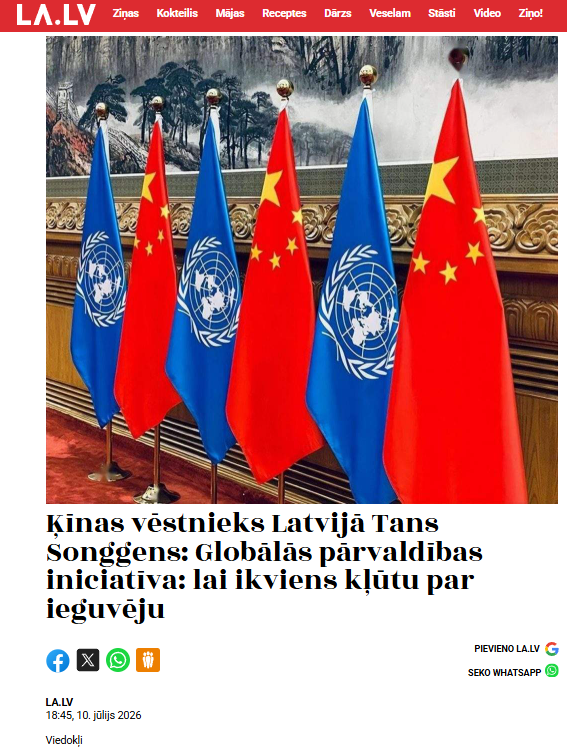
Global governance is a common endeavor that bears on the well-being of all humanity, and building a just and equitable global governance system is a shared vision long pursued by people from across the world. In 2025, President Xi Jinping proposed the Global Governance Initiative (GGI), offering a Chinese solution to the two pressing questions of the era: what kind of global governance system should be established, and how global governance can be reformed and improved.
The GGI is built on five core concepts: sovereign equality, the international rule of law, multilateralism, a people-centered approach, and real actions. By addressing the crux and root causes of crises and challenges, the initiative provides sound guidance for building a more just and equitable global governance system.
Upon its introduction around a year ago, the GGI swiftly gained support from nearly 160 countries and international organizations, with over 60 countries joining the Group of Friends of Global Governance. This echoes the strong call from the international community for fairness, rule of law, cooperation and actions, rather than hegemony, disorder, confrontation and empty talks.
On June 17, the Chinese government released a white paper titled “More Just and Equitable Global Governance: China’s Principles, Proposals and Actions.”, to systematically introduce China's principles, proposals and actions in global governance. Here are the key takeaways from the white paper:
Resolutely upholding the UN's authority and status is fundamental to the effective global governance. Eighty years after the establishment of the UN, the world underwent trials and tribulations, but did not go into a global war again. This fully shows that the future of humanity is closely interconnected and multilateral cooperation is the right way to address global challenges. Nowadays, the seeming failure of multilateralism is not because the UN is no longer important, but precisely because its authority and role have not been respected or brought into play. The resurgence of the "law of the jungle" is not because the UN Charter has become obsolete, but precisely because it has not been effectively observed and upheld.
China is the first country to put its signature on the UN Charter. No matter how the world changes, China firmly upholds the international system with the UN at its core, the international order based on international law, and the basic norms governing international relations underpinned by the purposes and principles of the UN Charter. China remains an active champion and strong proponent of multilateral cooperation.
Sense of responsibility bore by major countries is essential to the effective global governance. Equality is the premise of state-to-state relations. Major countries, particularly, should act by example in honoring equality, good faith, and cooperation, rather than leveraging their position of strength to engage in hegemonic, high-handed and abusive acts. Major countries are the key forces in advancing international rule of law and, therefore, should act by example in following rules and upholding the rule of law, rather than putting their own interests above international law or, even worse, imposing their own rules upon others.
At the San Francisco Conference after the World War II, Chinese delegates played a key role in advocating for the sovereign equality of all nations, no matter big or small, enshrined in the UN Charter. China, as a responsible major country, champions an equal and orderly multipolar world and a universally beneficial and inclusive economic globalization, and promotes a community of shared future for humanity. China has consistently been a builder of world peace, a contributor to global development, a defender of the international order, and a provider of public goods.
Unity and cooperation by all nations is most needed to the effective global governance. In today's world, all countries share a common stake in security and prosperity, and no one can stand aloof and unaffected. In responding to risks and challenges such as climate change, public health, and cyberspace security, it is important for the people to truly feel that countries are taking action and that unity can overcome all difficulties.
To make every member of the international community become a winner, China stands firmly on the side of win-win cooperation, taking concrete actions to pursue harmonious coexistence and seeking its own success while helping others succeed, which are advocated in the traditional Chinese philosophy. With its own approach to resolving hotspot issues. China is the second largest contributor to the UN peacekeeping budget and has sent more peacekeeping troops than any other permanent member of the UN Security Council. China is committed to openness, cooperation and common development. Under the framework of the Global Development Initiative, more than 1,800 cooperation projects have been launched. Unilateral zero-tariff treatment has been expanded to cover all African nations and least developed countries having diplomatic ties with China.
China has put forward the Global Initiative on Data Security and the Global AI Governance Initiative. When it comes to creating new platforms for global governance, China has initiated the establishment of the International Organization for Mediation and the World Data Organization, and is stepping up preparations for the World AI Cooperation Organization, promoting the improvement of governance rules for new domains. This autumn, we will also host the inaugural Xiong’an Global Governance Forum.
The GGI is another significant public good that China has contributed to the world after the Global Development Initiative, the Global Security Initiative, and the Global Civilization Initiative. The GGI breaks free from the outdated "core-periphery" theoretical framework of international relations, and discards the law of jungle characterized by "might makes right". The GGI, promoting democracy and the rule of law in international relations, outlines a new approach of global governance oriented towards extensive consultation, joint contribution, and shared benefits.
China and Latvia maintain a sound cooperation in global governance. Last year, China supported Latvia’s candidacy for a non-permanent seat in the United Nations Security Council. The Chinese side stands ready to work with all parties, including the Latvian side, to deliver on the Global Governance Initiative, uphold the central role of the UN, enable the Global South to play its pivotal role, address gaps and deficits in global governance, and strive to foster a more just and equitable global governance system.