


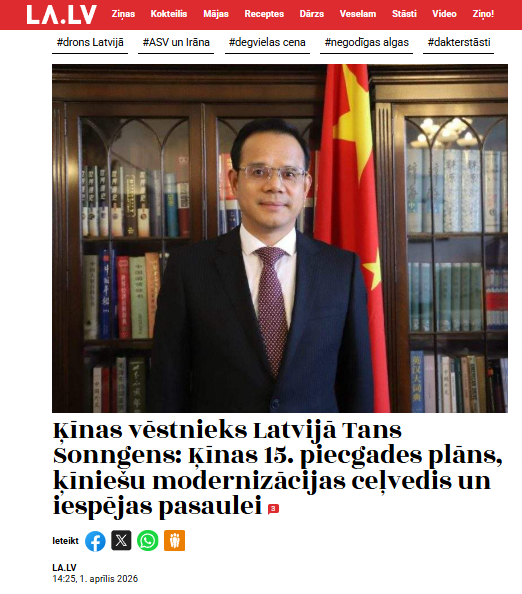
On April 1, 2026, a signed article by H.E. Mr. Tang Songgen, Chinese Ambassador to Latvia, titled “China’s 15th Five-Year Plan: Blueprint of Chinese Modernization and Opportunity to the World”, was published on LA.LV, website of Latvijas Avīze, in Latvian. Full text of its English version is as follows:
During the Two Sessions of China’s National People’s Congress (NPC) and Chinese People’s Political Consultative Conference (CPPCC) concluded recently, China’s 15th Five-Year Plan for economic and social development was adopted. As China has set the goal of basically realizing Chinese modernization by 2035, this Plan outlines a comprehensive plan toward the goal in the next 5 years. To put it more straightforward, I would like to introduce 6 key dimensions of this Plan.
The first is high-quality development, which is in line with the philosophy of an innovative, coordinated, green, open and shared development. Only by turning this philosophy into real actions can development well meet the people’s growing needs for a better life.
To pursue high-quality development, “new-quality productive forces” is grabbing spotlight. It refers to advanced productivity characterized by high-tech, high efficiency and high quality. Innovations of science, technology and industries are the fundamental approaches of developing new-quality productive forces. China is upgrading traditional industries, fostering emerging industries like integrated circuits and biomedicine, and future industries like quantum technology, embodied intelligence and brain-computer interface.
Economic development is not only driven by the supply side but also by the demand. With a market of 1.4 billion population and a middle-income group of more than 450 million, there is still great potential of demand from China’s national unified market to be unleashed.
Second, science & technology. It is a primary productive force. In recent years, China’s economy showed a clear shift toward innovation-driven development, with R&D spending intensity reaching 2.8%. In the next 5 years, the annual average increase in nationwide R&D spending will be 7%.
China will promote innovation and breakthroughs in key technologies, such as integrated circuits, industrial machine tools, high-end equipment, basic software, advanced materials, and bio-manufacturing. The “AI+” initiative, integrating artificial intelligence with traditional industries, will be further advanced and expanded.
Third, green transition. President Xi Jinping said that lucid waters and lush mountains are invaluable assets. Green transition is not only a need for a better life of people but also China’s best practice of responding to the global climate change.
In 2025, the combined installed capacity of wind and solar power reached 1.84 billion kilowatts, surpassing thermal power for the first time to become the largest source of electricity in China.
We will increasingly promote green and low-carbon transition. In the next five years, 17% in carbon dioxide emission per unit of GDP will be reduced. And ratio of non-fossil fuel use will increase from 21.7% to 25%.
Fourth, people’s well-being and common prosperity. People’s well-being is a top priority in the process of Chinese modernization. Since the founding of the People’s Republic of China, 800 million people have alleviated poverty, an unprecedented achievement in human history. Now, the average life expectancy of Chinese people is 79.25 years, and in the next five years, the number will reach to 80. In terms of education, 12.22 million students graduated from Chinese universities in 2025, and among them nearly 5 million are STEM students.
Fifth, ensuring both development and security. It is essential for China to consolidate security in the course of development. We believe that security lies in swift adaption to the changing world, rather than sticking to the past.
It is for this reason that China proposes Global Security Initiative, advocating common, comprehensive, cooperative and sustainable security. Compared with “peace through strength”, peace through development is much more agreed by the Chinese people.
Sixth, high-standard opening-up. In recent years, China’s contribution to the global economic growth was more than 30%. In the next five years, China aspires to be not only the world's factory but also the world's market.
We will continue to expand opening-up at the institutional level, expand market access and open up more areas, particularly in the service sectors. China will firmly uphold the rules-based multilateral trading system with the WTO at its core and opposes all forms of unilateralism and protectionism.
All six dimensions of China’s 15th Five-Year Plan reflect continuity, peace orientation, and certainty of China’s policy. Pursuing an independent foreign policy of peace, China has always been focusing on managing its own affairs well and sharing development opportunities with all countries across the world.
Despite global challenges, China’s policy provides certainty to the world. And China believes that Europe should naturally be a pole in a multipolar world, that Europe is an important force underpinning the stability of the international order, and that Europe is a partner for China in its modernization process.
China-Europe cooperation has already shown with facts that interdependence is not a risk; intertwined interests are not threats; and openness and cooperation will not weaken economic security; but building walls and barriers will only lead to self-isolation.
I sincerely hope Latvia and Europe could embrace opportunities brought by the Chinese modernization and jointly build a better future for the world.