







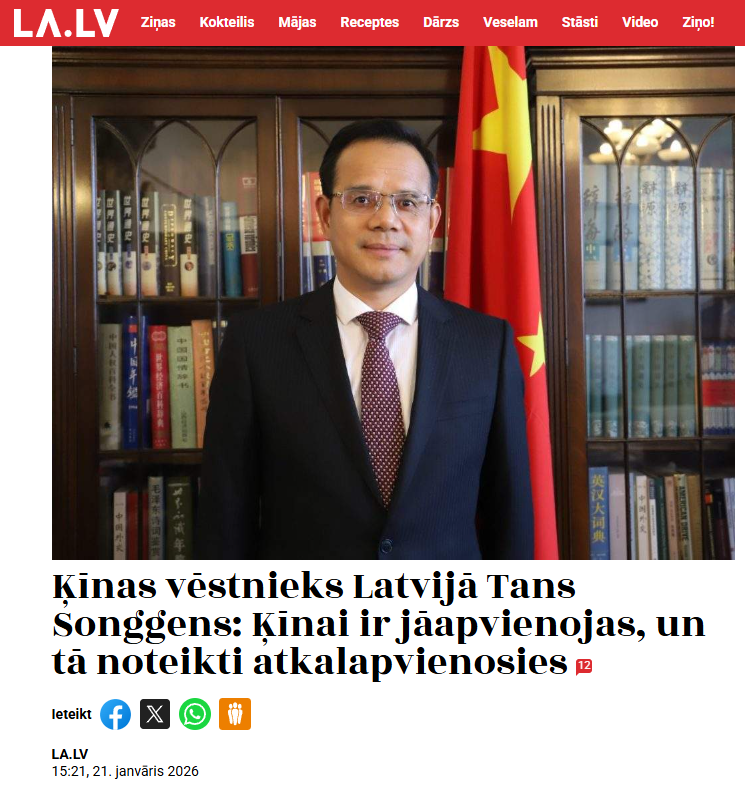
On January 21, 2026, a signed article by H.E. Mr. Tang Songgen, Chinese Ambassador to Latvia, titled “China must be reunified, and will surely be reunified”, was published on the main page of LA.LV, website of Latvijas Avīze, in Latvian. Full text of its English version is as follows:
Recently, a few individuals and media outlets muddle the international and regional hot-spot issues like Ukraine and Venezuela with the Taiwan question without justification. By neglecting and distorting facts, they are deliberately misleading the public so as to instigate chaos.
The Taiwan question is purely China's internal affair. Resolving the Taiwan question is a matter for the Chinese people themselves, brooks no external interference. The de jure and de facto basis for the one-China principle is solid and unshakable.
One-China principle has a solid basis in history and jurisprudence
Taiwan has always been an inalienable part of China's territory since ancient time. From the 12th century onwards, different central governments of China throughout the time all set up administrative bodies to exercise jurisdiction over Taiwan and Penghu, an archipelago in the Taiwan Strait. In 1684, a Taiwan prefectural administration was set up under the jurisdiction of Fujian Province. In 1885, the Qing dynasty made Taiwan a full province, then the 20th province of China.
In 1895, through the Sino-Japanese War, Japan stole Taiwan and Penghu, illegally occupied these islands for 50 years. The Cairo Declaration, issued by China, the United States and the United Kingdom on December 1, 1943, stated that it was the purpose of the three allies that all the territories Japan had stolen from China, such as Northeast China, Taiwan and the Penghu Islands, should be restored to China. The Potsdam Proclamation, signed by China, the U.S. and the UK on July 26, 1945 reiterated: "The terms of the Cairo Declaration shall be carried out." In September of the same year, Japan signed the instrument of surrender, in which it promised that it would faithfully fulfill the obligations laid down in the Potsdam Proclamation. On October 25 1945, the Chinese government announced that it was resuming the exercise of sovereignty over Taiwan, and the ceremony to accept Japan's surrender in Taiwan Province of the China war theater of the Allied powers was held in Taipei.
Taiwan's recovery to China is a victorious outcome of WWII and an integral part of the postwar international order. From that point forward, China had recovered Taiwan de jure and de facto through a host of documents with effectiveness of international law. Taiwan -- a part of China -- was restored to its motherland.
In 1949, the People's Republic of China (PRC) was founded, becoming the successor to the Republic of China (1912-1949). The new government replaced the previous KMT regime in a situation where China, as a subject under international law, did not change and China's sovereignty and inherent territory did not change. As a natural result, the government of the PRC should enjoy and exercise China's full sovereignty, which includes its sovereignty over Taiwan.
One-China principle is the premise and foundation for UNGA Resolution 2758 passed in 1971, while the resolution solemnly confirms and fully embodies the one-China principle. The resolution makes it clear that there is but one China in the world and the Government of the People’s Republic of China is the only legitimate representative of the whole of China, including the Taiwan region. There is no such thing as “two Chinas” or “one China, one Taiwan.” It is clearly stated in the official legal opinions of the Office of Legal Affairs of the U.N. Secretariat that “the United Nations considers ‘Taiwan’ as a province of China with no separate status” and the “‘authorities’ in ‘Taipei’ are not considered to ... enjoy any form of government status.” All official U.N. documents referred to Taiwan as “Taiwan, Province of China.”
Strong exchanges across the Taiwan Strait
Chinese civilization is distinguished by its unity. National unity always remains at the core of national interests. Completing national reunification is a long-cherished aspiration shared by all Chinese people. Supported by the wisdom and strength of over 1.4 billion Chinese people, the public will for national reunification is immensely solid, its foundation extraordinarily deep and its power incomparably strong.
Under the leadership and guidance of the central government of China, cross-Straits relations have made tremendous progress over the past years, particularly the wide-ranging policies and measures from the mainland that benefit Taiwan compatriots, accords with the heartfelt wishes of the vast majority of the residents on the island of Taiwan and has shaped mainstream public opinion on the island that calls for peace, development, exchange and cooperation.
In 2025, cross-Strait travel exceeded 5 million trips, reaching a new high in nearly six years. From January to November, the Mini Three Links, which refers to trade, shipping and postal service, operated 10997 voyages, year-on-year growth of 38.69%. In the same period, cross-Straits trade totaled $285.395 billion, up 7.3 percent year on year.
There is a growing call for cross-strait reunification. The “de-sinicization” and “gradual Taiwan independence” perpetrated by the “Taiwan independence” separatist forces have no space or chance whatsoever, and their schemes to deceive Taiwanese compatriots will not succeed. Resolving the Taiwan question and achieving China's reunification has entered an irreversible historical process.
China must be reunified, and will surely be reunified
Some individuals have kept talking about “maintaining the status quo across the Taiwan Strait” with ulterior motives. The real status quo across the Taiwan Straits is that both sides of the Straits belong to one and the same China, and Taiwan is an inalienable part of China's territory. People from Chinese mainland and Taiwan island are all Chinese, speaking the same language, using the same characters, celebrating the same festivals, and honoring the same ancestors. The biggest threat to peace and stability across the Taiwan Strait comes from the separatist activities of small handful of "Taiwan independence" forces and the external connivance and support. No one values peace across the Taiwan Strait more than the Chinese people. We are ready to create vast space for peaceful reunification, but we will leave no room for separatist activities in any form. We will not accept any attempt by anyone or any force to use maintaining cross-Strait peace as an excuse to curb our efforts to stop “Taiwan independence” separatist moves.
The Taiwan authorities have lately been clamoring for so-called “global supply chain stability”. This claim is nothing but lies driven by political motives to solicit external support for “Taiwan independence”. Sovereignty is not for negotiation. Sovereignty and "supply chain stability" are not on the same level at all. No one should underestimate the Chinese people's determination, and strong ability to defend national sovereignty and territorial integrity.
I would like to reiterate that Ukraine and Venezuela are sovereign states, while Taiwan is inalienable part of China, and the Taiwan question is China's internal affair. They are fundamentally different. No one has the right to make irresponsible remarks about China's internal affairs. The one-China principle is a basic norm governing international relations and a prevailing consensus of the international community. Cross-strait reunification is unstoppable. It is where the arc of history bends and public opinion trends.