







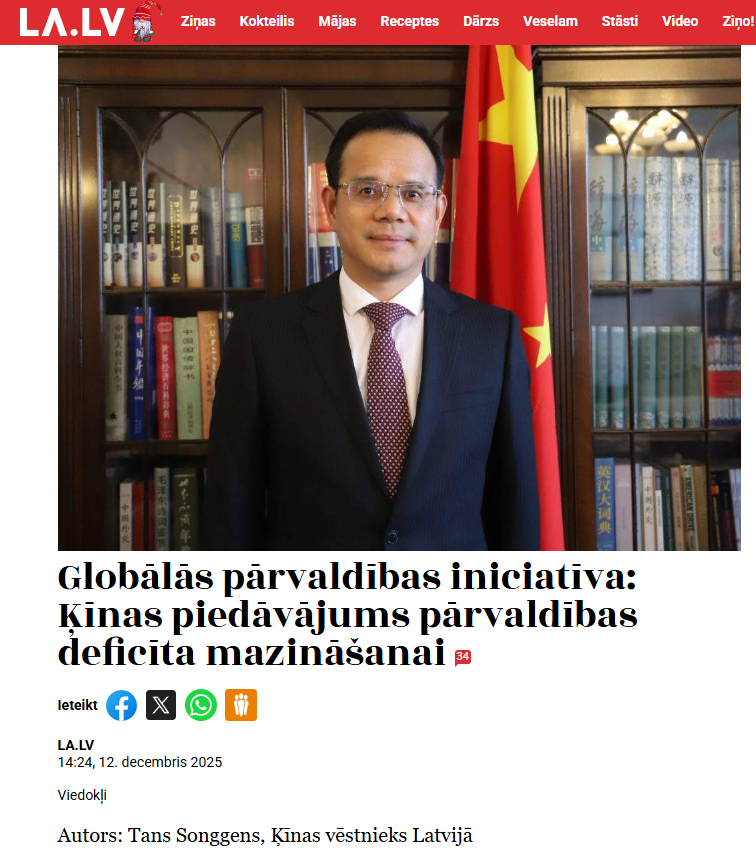
On December 12, 2025, a signed article by H.E. Mr. Tang Songgen, Chinese Ambassador to Latvia, titled “Global Governance Initiative: A Chinese Proposal to the Governance Deficit”, was published on LA.LV, website of Latvijas Avīze, in Latvian. Full text of its English version is as follows:
This year marks the 80th anniversary of the founding of the United Nations (UN). Eighty years after the establishment of the UN, the world has undergone trials and tribulations. Fortunately, it did not go into a global war again, thanks to the indispensable role of the UN. This clearly shows that multilateralism, peaceful development, and win-win cooperation are common pursuits of the world.
This year also marks the 80th anniversary of the victory of the Chinese People’s War of Resistance Against Japanese Aggression. As the main Eastern battlefield, China made important contribution to the victory against Fascism including Japanese militarism, with 35 million casualties after 14-year-long fighting.
As the founding member of the UN and permanent member of the UN Security Council (UNSC), China was among the first to sign the UN Charter upon its founding. At the San Francisco Conference, Chinese delegates championed national self-determination and anti-colonialism, playing a key role in advocating for the sovereign equality of all nations, no matter big or small, enshrined in the UN Charter. Five Principles of Peaceful Coexistence, specified for the first time by China, namely, mutual respect for sovereignty and territorial integrity, mutual non-aggression, mutual non-interference in each other's internal affairs, equality and mutual benefit, and peaceful coexistence, have already become basic norms for international relations and fundamental principles of international law.
80 years after aforementioned historical moments, the international landscape is undergoing changes and turbulence. Unilateralism, protectionism and hegemonic practices are running rampant. The UN and multilateralism are being challenged. Number of armed conflicts worldwide has reached a new high since World War II, and more than 600 million people are experiencing hunger. Calls for reform and improvement of the global governance system to make it more just and equitable grow louder with each passing day, especially from the developing countries.
Faced with global challenges, no country can stay unaffected. China, as the largest developing country, a permanent member of the UNSC, as well as an important member of the Global South, focusing on a subject of our times, namely what kind of global governance system to build and how to reform and improve global governance, put forward the Global Governance Initiative (GGI). This Initiative meets the common wishes of the people and the urgent needs from the world.
The GGI guides the direction for reforming and improving the global governance system from five aspects: Staying committed to sovereign equality means advocating countries to participate in, make decisions in and benefit from the global governance process as equals. Staying committed to international rule of law, meaning that international law and rules must be applied equally and uniformly, without any double standards or imposition. Staying committed to multilateralism means enhancing UN’s role as the core platform. Staying committed to the people-centered approach means ensuring that people of all countries participate in global governance and share its benefits. Staying committed to real results means seeking practical results and finding sustainable solutions.
Highly aligned with the purposes and principles of the UN Charter, the GGI upholds the vision of global governance featuring extensive consultation and joint contribution for shared benefit. It has been warmly welcomed by the UN and the international community with more than 140 countries and international organizations responding positively.
GGI is the fourth major global initiative and public goods proposed by China, following those on development, security, and civilization. With their respective priorities, the four initiatives together provide stability and certainty in a changing and turbulent world, and reflect China’s sense of responsibility in the international affairs.
China believes that to reform and improve global governance does not mean to overturn the existing international order or to create another framework outside the current international system. Rather, the goal is to make the existing international system and international institutions better at taking actions, working effectively, adapting to changes, responding promptly and effectively to various global challenges, and serving the interests of all countries, particularly developing ones. China has always acted and will act as a builder of world peace, a contributor to global development, a defender of the international order, and a provider of public goods.
This year has been a significant year for Latvia as well, elected as a non-permanent member of the UNSC for 2026-2027.
I noted that during the election campaign, Latvia emphasized upholding the UN Charter, strengthening the resilience of the multilateral system and finding solutions together, and focused on areas like Sustainable Development Goals, protection of civilians, gender equality, and fighting climate change. It can be said that in multilateral affairs, China and Latvia share many concerns and have broad scope for cooperation.
Looking ahead, China is ready to practice the true multilateralism and safeguard the international system with the U.N. at its core and the international order underpinned by international law, together with all countries including Latvia. Under the guidance of the Global Governance Initiative, China is ready to work with all countries to promote the building of a more just and equitable global governance system and work together for a community with a shared future for humanity, so as to make positive contribution to build a world with enduring peace and common prosperity.