







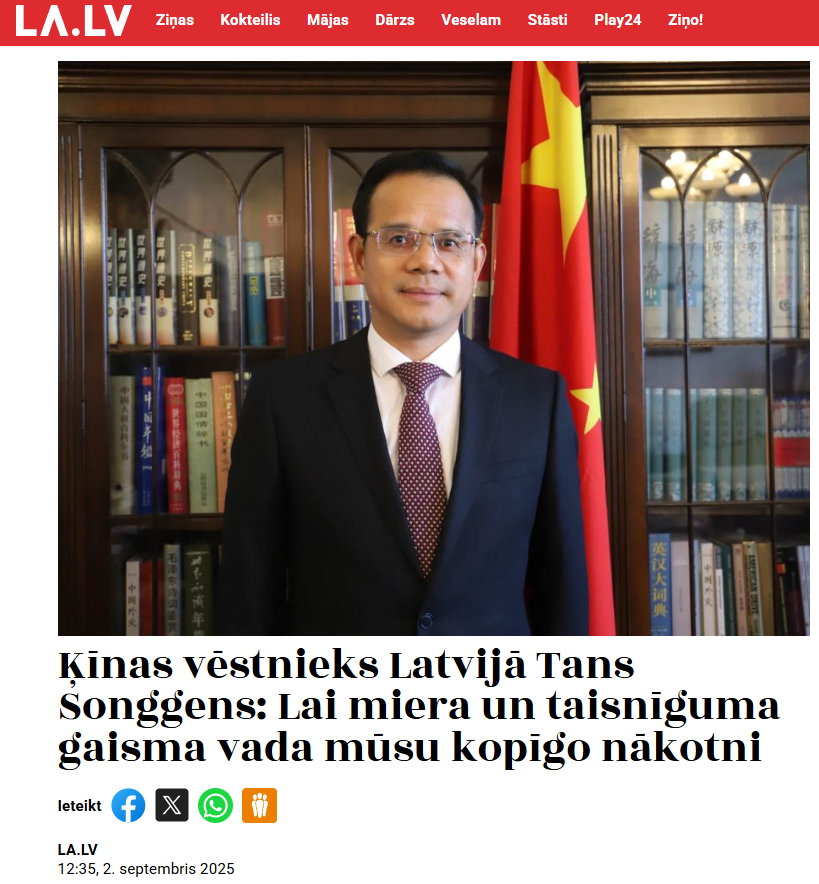
On September 2, 2025, on the occassion of the 80th anniversary of the victory in the Chinese People's War of Resistance Against Japanese Aggression and the World Anti-Fascist War, a signed article by H.E. Mr. Tang Songgen, Chinese Ambassador to Latvia, titled “Let the Light of Peace and Justice Guide Our Shared Future”, was published on LA.lv, website of Latvijas Avīze, in Latvian. Full text of its English version is as follows:
The 3rd of September marks the 80th anniversary of the victory of the Chinese People’s War of Resistance Against Japanese Aggression. For 14 years and more, the Chinese people fought valiantly against Japanese militarism and sacrificed tens of millions of soldiers and civilians to fracture the Axis strategy, in the territory of China, the World Anti-Fascist War’s dragging, sprawling, brutal, and equally vital main Eastern battlefield.
China’s resistance was the first to ignite and last to extinguish in the World Anti-Fascist War. Long before Nazi Germany’s blitzkrieg of Poland and Japan’s attack on Pearl Harbor, Asia burned after the 1931 Mukden Incident (known in China as the September 18th Incident), staged by the Japanese Kwantung Army. Chinese soldiers and civilians waged relentless guerrilla wars across frozen plains in the occupied Northeast China. Data from well-documented Japanese military archives confirm that between 1937 to 1945, 70 to 94 percent of its army divisions were perpetually committed to the Chinese mainland.
China not only resisted Japanese aggressors at home but also provided crucial strategic support to the Allies. “The Hump” airlift transport delivered hundreds of thousands of tons of fuel and munitions to Allied forces in Burma, India and China. Chinese farmers rescued over 1,000 downed U.S. airmen flying this perilous yet strategic lifeline; Chinese workers hauled essential war materials like tungsten and tung oil along the Yangtze River under bombardment to feed Allied war production and maintenance.
The then U.S. President Franklin D. Roosevelt stressed for multiple times the importance of the China theater to the Allied countries’ very survival and victory, to the effect that without China holding the line, Japan could slice through Burma, throttle India, seize Australia, and link hands with the Nazis in the Caucasus.
Chinese and European people forged a profound bond of shared future. In the war's darkest moments, fishermen from Zhoushan, Zhejiang, risked their lives to rescue 384 British POWs from the sinking Japanese troopship “Lisbon Maru”. Chinese diplomat Ho Feng-Shan issued visas to enter Shanghai to thousands of Jewish refugees, risking his own life and career. Dr. Qian Xiuling saved the lives of several Belgian resistance fighters and hostages from the Fascists. German John Rabe and Danish Bernhard Arp Sindberg went to great lengths to protect the Chinese people during the bloody, notorious Nanjing Massacre.
In 1945, as a victorious nation, China was among the first to sign the Charter of the United Nations (UN) upon the founding of the UN, laying the foundation of the postwar international order. As a founding member of the UN and permanent member of the Security Council, China has translated wartime fortitude into new international principles. At the San Francisco Conference, Chinese delegates championed national self-determination and anti-colonialism, playing a key role in advocating for the sovereign equality of all nations, no matter big or small, enshrined in the Charter of the United Nations.
Taiwan’s return to China was indeed an integral part of the fruits of the victory of WWII and the postwar international order. In the late 19th century, Japan forcibly seized Taiwan through war of aggression. For 50 years, the Taiwanese people never ceased resisting Japanese occupation. The Cairo Declaration and the Potsdam Proclamation explicitly mandated that Taiwan, which Japan has stolen, be returned to China. These instruments with legal effect under international law have all affirmed China’s sovereignty over Taiwan and become part of the postwar international order. The Resolution 2758, adopted by the U.N. General Assembly in 1971, unequivocally recognizes the People’s Republic of China’s sovereignty over Taiwan. Since then, the only reference to the Taiwan region in the U.N. is “Taiwan, Province of China.”
Today, 183 countries including Latvia, representing the overwhelming majority of U.N. member states, have established diplomatic ties with China based on the one-China principle as the political foundation. This reflects that the one-China principle is the global consensus and prevailing trend of our times.
To bear history in mind is not to perpetuate hatred. Rather, its purpose is to ensure that mankind does not forget its lessons. Remembering history does not mean being obsessed with the past. Rather, in doing so, we aim to create a better future and pass the torch of peace from generation to generation.
Having fought valiantly in the War of Resistance Against Japanese Aggression, the Chinese people cherish peace profoundly. It is the top contributor of peacekeepers among the five permanent members of the UNSC, the second-largest contributor to the UN budget, and has the best track record with respect to security among major countries. Since the founding of the People’s Republic of China, it has never initiated a war nor seized a single inch of another country's land. China remains firm in pursuing an independent foreign policy of peace and has always decided its position and policy on issues based on their own merits. On the Ukraine issue, China has put forward four principles, namely, the sovereignty and territorial integrity of all countries should be respected, the purposes and principles of the UN Charter should be observed, the legitimate security concerns of all countries should be taken seriously, and all efforts conducive to a peaceful settlement of the crisis should be supported. These principles are all the more relevant given the current circumstances. China proposed the Global Security Initiative (GSI), advocating a vision of common, comprehensive, cooperative and sustainable security. China has been actively playing a constructive role in global hotspots. China’s development strengthens the force for global peace.
This year also marks the 50th anniversary of the founding of China-EU diplomatic relations. Faced with instability and uncertainty nowadays, we need not the law of the jungle, but a shared future; not bullying and hegemony, but win-win cooperation; not overturning the postwar international order, but safeguarding the fruits of the victory of World Anti-Fascist War. The more challenging and complex the international situation becomes, the more China and the EU need to strengthen communication, enhance mutual trust, and deepen cooperation. We must heed the lessons of that sacrifice, and uphold together the common values of humanity, namely, peace, development, fairness, justice, democracy, and freedom, so as to realize the vision of a community with a shared future for humanity.