







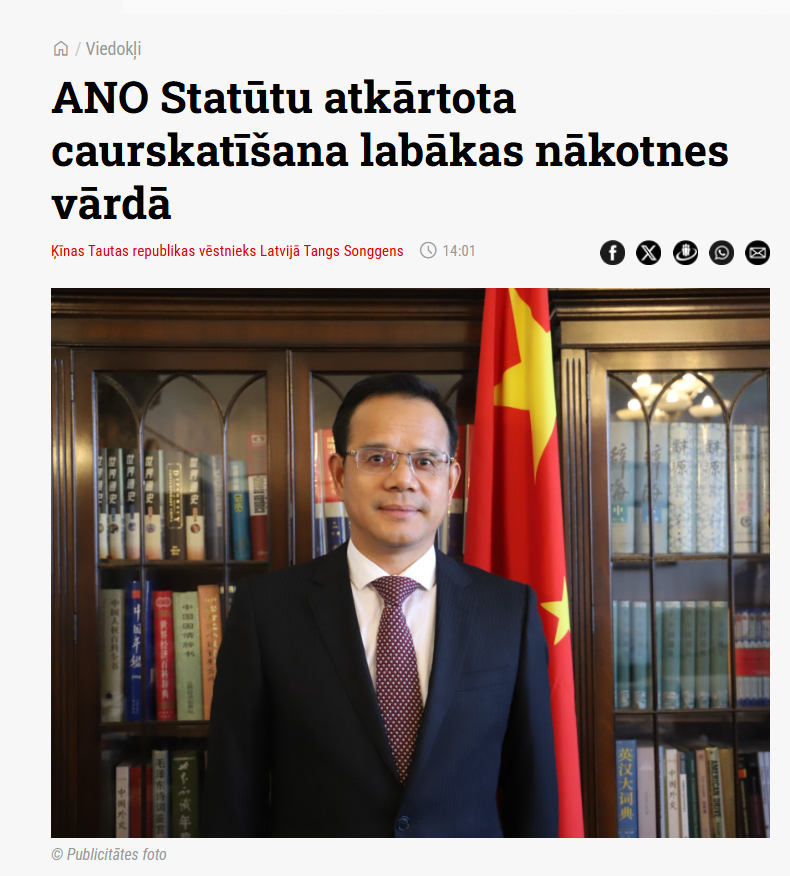
On July 2, 2025, a signed article by H.E. Mr. Tang Songgen, Chinese Ambassador to Latvia, titled “Revisiting the UN Charter for a better future”, was published on NRA.lv, website of Neatkarīgā rīta avīze, in Latvian. Full text of its English version is as follows:
June 26 this year marks the 80th anniversary of the signing of the Charter of the United Nations. The signing of the UN Charter and the founding of the United Nations declared the steadfast commitment of the international community to ending the scourge of war and promoting cooperation, which ushered in a new historic chapter of countries working together for peace and development. 80 years on, amidst shifting international dynamics, the purposes and principles of the UN Charter have shown everlasting relevance, becoming the fundamental guidance for handling international relations and a crucial cornerstone for the stability of the international order.
China was the first country to put its signature on the UN Charter. For us, the birth of the United Nations, after a great cost of lives, holds profound significance. From 1931 to 1945, China valiantly resisted the aggression of Japanese militarists for 14 years at the devastating cost of 35 million military and civilian casualties, pinning down the bulk of Japan's overseas forces in China’s territory, the oriental battlefield of World War II. China made tremendous sacrifices and contributions to the victory of the World Anti-Fascist War.
Eighty years after the establishment of the UN, the world underwent trials and tribulations, but did not go into a global war again. This fully shows that the future of humanity is closely interconnected and multilateral cooperation is the right way to address global challenges. China has all along strictly followed the norms governing international relations, faithfully fulfilled its international obligations. It is the top contributor of peacekeepers among the five permanent members of the UNSC, the second-largest contributor to the UN budget, and has the best track record with respect to security among major countries. Since the founding of the People’s Republic of China, it has never initiated a war nor seized a single inch of another country's land. China is currently advancing a path of Chinese modernization, and this is a modernization of peaceful development. We believe that the more turbulent and complex the international situation becomes, the more imperative it is to uphold and defend the authority of the United Nations, firmly uphold the U.N.-centered international system, the international order underpinned by international law, and the basic norms of international relations based on the purposes and principles of the U.N. Charter.
There has been a rhetoric that China is trying to "revise" the postwar international order or even create a new one. This is entirely groundless. China has developed within the current international order. It is also a beneficiary and defender of it. One undeniable fact is that Taiwan’s restoration to China in 1945 is a victorious outcome of WWII and an integral part of the postwar international order. A series of instruments with legal effect under international law, including the Cairo Declaration, the Potsdam Proclamation, and the Japanese Instrument of Surrender in 1945, have all affirmed China’s sovereignty over Taiwan, and laid the groundwork of the postwar international order. The current international order affirms the one-China principle, and China has no reason to change it or to let it change.
Nowadays, global transformation unseen in a century is unfolding in profound ways. Unilateralism, protectionism and hegemonic bullying are intensifying, seriously disrupting international rules and dealing a blow to world economic stability and recovery. The world has once again come to a critical crossroads. The more turbulent the times, the greater the need for solidarity. President Xi Jinping put forward the vision of building a community with a shared future for mankind and the Global Development Initiative, Global Security Initiative and Global Civilization Initiative. These are China’s proposals to jointly tackle global challenges and build a better world, namely an equal and orderly multipolar world and universally beneficial and inclusive economic globalization. They have won the recognition and support of more and more countries.
This year marks the 50th anniversary of diplomatic relations between China and the European Union. China has always regarded European countries, including Latvia, as partners. Both China and the EU support multilateralism and economic globalization. A sound and stable China-EU relationship not only works to the advantage of both sides but also brings benefits to the whole world.
Not long ago, Latvia was successfully elected as a non-permanent member of the United Nations Security Council for the term 2026-2027, with a vote in favor from China. The Chinese side is ready to work with the Latvian side to practice true multilateralism, safeguard the central role of the U.N., promote global governance that is based on extensive consultation, joint contribution and shared benefit, and facilitate just and lasting settlement of global conflicts including the Ukraine crisis. Together, we could bring stability to a changing and turbulent world, inject positive energy in building a more just and equitable global governance system, work toward the vision of a community with a shared future for mankind, and embrace an even brighter future.